
The ISRO is aiming for a soft landing of the lander in the South Pole region of the moon where no country has gone so far.

ISRO Chairman K Sivan said there might by a postponement if the weather was not conducive.
The space agency has set 2020 as the deadline for the first privately built rocket to be launched into space.

The Mars mission should not have been a priority at this stage for India which, instead, ought to have devoted time and energy on getting its rocket operational again and give momentum to the human space flight programme, former ISRO chief G Madhavan Nair said.

K Sivan has to hasten the effort to bring in private players into satellite and rocket building and replicate India's software success in aerospace.

A truly 'made in India' satellite that will empower a digital India.

'India has got a unique opportunity to get more and more business from outside as India is cost-effective and reliable.'

Aditya-L1 is meant to observe the corona, which are the outer layers of the Sun, extending to thousands of kilometres.

Hit by inclement weather, the launch of India's latest communication satellite GSAT-16 was deferred for the second time after it was rescheduled to be put into space in the early hours on Saturday by Ariane 5 rocket from the space port of Kourou in French Guiana.
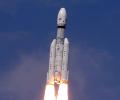
'ISRO takes a very cautious approach.' 'After reaching the moon, the orbit has to be brought down from a single elliptical orbit to a circular orbit while simultaneously ensuring the stability of Chandrayaan 3 and the health parameters of the lander and rover.'

The feat is the second one for the Indian Space Research Organisation scientists in using the indigenously made cryogenic stage after the January 5, 2014 launch of GSLV-D5.

"Efforts are underway to establish the link with the satellite," it added.

It also carries equipment for meteorological data relay and satellite based search and rescue services being provided by earlier INSAT satellites.

Rajeev Srinivasan on the disastrous after-effects of a made-up spying incident
From relying on Russia for its first satellite launch, India is fast becoming a global hub to launch satellites, says T E Narasimhan
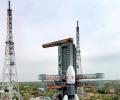
'In a part of the world where the government tells people what not to eat and what slogans to shout and not shout, it is beneficial to develop a mentality that is science minded and therefore open-minded.' 'That is possibly why the space programme has always had support from all sides of the political divide,' says Aakar Patel.

The year ended with the launch of the PSLV's 50th mission.

GSAT-6, the country's latest communication satellite has been successfully positioned in its orbital slot, Indian Space Research Organisation said on Sunday.
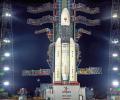
Late on Monday night, in a last-minute revision of schedule, ISRO announced that the launch of India's second lunar mission 'Chandrayaan-2' has been called off due to a technical snag.

'By pushing PSLV production to industry, the extra ISRO personnel available will be utilised to do projects like the human space mission.'

Dr Rao accelerated the development of rocket technology which led to the successful launch of ASLV and PSLV satellites.
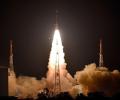
"I am really grateful to the entire ISRO family for having worked this hard and making IRNSS-1I a success," said the space centre's chief K Sivan.

India will be the fourth country after the United States, Russia and China to send humans to space.

Since Pakistan has 'opted out' of the project, it is now being called South Asian satellite.
The BJP hit back accusing the Congress of drawing the issue into political arena.
According to ISRO officials, Earth bound orbit is a phase during which the spacecraft will remain in the Earth's sphere of influence.

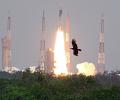
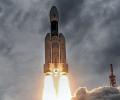
India on Monday successfully launched its second lunar mission Chandrayaan-2 onboard its powerful rocket GSLV-MkIII-M1 from the spaceport in Sriharikota to explore the unchartered south pole of the celestial body by landing a rover. Following the successful launch, leaders across the political spectrum congratulated the Indian Space Research Organisation for its hard work.

Indian Space Research Organisation has successfully realigned the orbit of its Mars Orbiter Mission 'Mangalyaan' so it is not affected by long-duration eclipse, ISRO Chairman A S Kiran Kumar said.

The primary goal of HysIS, whose mission life is five years, is to study the earth's surface in visible near infrared and shortwave infrared regions of the electromagnetic spectrum.
"First orbit raising operation of GSAT-6 was successfully completed by firing the Apogee Motor for 3385 seconds at 8:35 pm IST on August 28," the ISRO said.
The Vikram Moon Lander, named after the father of India's space mission Vikram Sarabhai on his birth centenary year, is scheduled to touch the lunar surface near its south pole on September 7 about 1.55 am.

"I am extremely happy to announce that GSLV Mark III successfully injected Chandrayaan 2 in the defined orbit, infact the orbit is 6,000 km more than what was intended," Sivan said.

ISRO Chairman K Sivan described the GSAT-11 as the "richest space asset" for India.
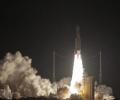
Boosting India's communication services, its latest satellite GSAT-16 was successfully launched on board Arianespace rocket from the spaceport of Kourou in French Guiana in the early hours of Sunday, after a delay of two days due to bad weather.

GSAT-18, which aims at providing telecommunications services for the country by strengthening ISRO's current fleet of 14 operational telecom satellites, was launched into a Geosynchronous Transfer Orbit about 32 minutes after the lift-off.

India, with its demonstrated capabilities of undertaking low cost high value inter-planetary travel, offers great opportunities for NASA to work with.

Scientists also expressed the hope that any technical problem will be sorted out by ISRO, and the mission will be launched successfully.
"The duration of manoeuvre was 1,738 seconds. With this, Chandrayaan-2 was successfully inserted into a Lunar orbit," Indian Space Research Organisation said.

One spacecraft will be Indian Space Research Organisation's own Chandrayaan-2, while the other will be from India's first private moonshot Team Indus which is competing in the Google LunarXPrize challenge.

The ISRO lost communication with the satellite when it attempted to ignite the engine in a third and final move to its desired location.
